
Why “Non-Stim Energy” Is One of the Fastest-Growing Trends in Sports Supplements
Non-stimulant energy supplements, adaptogens, and recovery-focused wellness are becoming major trends in sports nutrition. Learn why athletes are rethinking performance support.
Held Performance
5/8/20263 min read
For years, energy products followed the same formula:
More caffeine.
More stimulation.
More intensity.
And for a while, that worked.
Until people started noticing the downside.
The crash.
Poor sleep.
Needing more caffeine just to feel normal.
Feeling mentally wired but physically exhausted.
That shift is one reason why one of the fastest-growing supplement trends right now is non-stimulant performance support.
Consumers are increasingly looking for ways to support:
energy consistency
focus
training readiness
stress resilience
recovery quality
…without feeling overstimulated all day.
And honestly, the trend makes sense.
More stimulation is not always more performance
A lot of active people are no longer asking:
“How strong is this pre-workout?”
They are asking:
“Why do I feel burned out even when I’m doing everything right?”
That is a very different conversation.
Research published in Sports Medicine and Nutrients continues exploring how sleep quality, recovery load, psychological stress, and nervous system fatigue influence athletic performance and perceived energy levels (Fullagar et al., 2015; Vitale et al., 2019).
Many people eventually realize that high stimulation can sometimes mask fatigue instead of addressing the behaviors around it.
That realization is changing buying behavior across the supplement industry.
The rise of “stable energy” supplements
One of the biggest wellness shifts right now is the movement away from products designed purely around intensity spikes.
Instead, consumers are increasingly interested in:
adaptogens
botanical support
non-stimulant routines
recovery-focused wellness
sustainable daily performance support
This trend is especially noticeable among:
athletes training multiple days per week
professionals balancing work and training
consumers prioritizing sleep quality and recovery
Research in Nutrients and Frontiers in Nutrition has explored how recovery quality, stress load, and sleep patterns may influence overall performance readiness and perceived energy (Kerksick et al., 2018).
Adaptogens are becoming part of sports nutrition
Ingredients once viewed as “wellness products” are increasingly crossing into sports performance routines.
That includes compounds such as:
ashwagandha
rhodiola
fenugreek
Several published studies have investigated adaptogenic ingredients in relation to stress response and exercise performance.
Examples include:
Wankhede et al. (2015), which investigated ashwagandha supplementation alongside resistance training.
Panossian & Wikman (2010), which discussed adaptogens and stress-response regulation.
Poole et al. (2010), which explored fenugreek supplementation in resistance-trained populations.
Interest in ingredients such as maca and fenugreek has also increased significantly within performance-focused wellness routines.
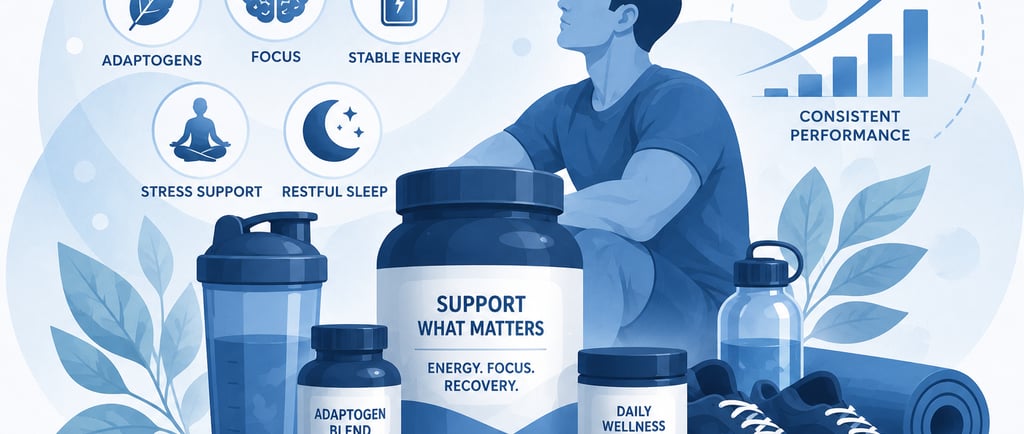
Products such as RIGHT, Adaptogen Blend, and Daily Wellness Support may fit structured routines depending on individual needs and professional guidance.
Consumers are connecting energy with recovery
One of the biggest mindset changes happening right now:
People are starting to understand that energy is not always about stimulation.
In many cases, consistent energy is influenced by:
sleep quality
stress load
hydration
recovery habits
nutrition consistency
Research in exercise physiology continues supporting the relationship between sleep quality and athletic readiness (Dattilo et al., 2011).
That is one reason nighttime support products and structured recovery routines continue gaining momentum.
Products such as Resurge, Hydration Support, and Recovery Formula are increasingly being integrated into broader wellness-focused performance systems.
Why many consumers are reducing caffeine load
Another noticeable trend:
People are becoming more aware of the trade-offs associated with excessive stimulant use.
High caffeine intake may:
affect sleep quality
increase jitteriness in some individuals
contribute to inconsistent energy patterns depending on timing and total intake
That does not mean caffeine is inherently bad. It simply means more consumers are looking for better balance.
For some people, that means:
reducing stimulant-heavy pre-workouts
cycling caffeine intake
integrating non-stimulant support into their routine
Simplicity is becoming premium
Another major trend:
Consumers increasingly associate quality with:
transparency
purposeful formulas
fewer unnecessary ingredients
clinically studied compounds
third-party testing
Organizations such as NSF International and U.S. Pharmacopeia continue influencing expectations around supplement quality and manufacturing standards.
The “kitchen sink” era of sports supplements may slowly be losing momentum.
Final thought
The future of sports supplements may not belong to the loudest products.
It may belong to the products that fit real life better.
People still want performance.
They still want results.
But increasingly, they also want:
consistency
sleep quality
sustainable routines
calmer energy
smarter recovery
That shift is already changing the supplement industry.
This content is for informational purposes only. Supplement use, training strategies, and wellness routines should always be individualized. What may be appropriate for one person may not be suitable for another due to differences in physiology, medications, health status, and training demands. Guidance from a qualified healthcare professional is strongly recommended before beginning any supplement routine.
These statements have not been evaluated by the Food and Drug Administration. These products are not intended to diagnose, treat, cure, or prevent any disease.