
Why Magnesium Is the Most Underrated Recovery Supplement in 2026 — And What Science Actually Says
Athletes are sleeping better, recovering faster, and reducing muscle cramps — all with magnesium glycinate. Discover what 2025–2026 clinical research says about the most overlooked recovery mineral, and why third-party tested quality matters.
Held Performance
5/27/20265 min read
When athletes talk about recovery, the conversation usually goes straight to protein, creatine, or sleep routines. But a growing body of research — and a major trend among elite athletes heading into 2026 — points to one mineral that most people are chronically deficient in and systematically underestimating: magnesium.
Not just any form of magnesium. Magnesium glycinate — a highly bioavailable chelated form — has emerged as the gold standard for athletes who want to improve sleep quality, reduce muscle cramps, support nervous system recovery, and maintain optimal performance under training stress.
68% of Americans are deficient in magnesium (NHANES data)
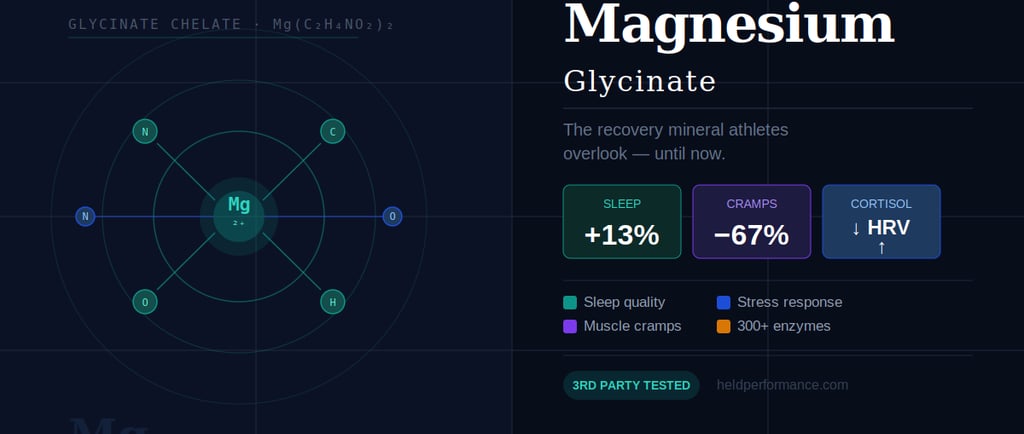
+13% Improvement in sleep efficiency with magnesium supplementation
300+ Enzymatic reactions in the body that require magnesium
The Magnesium-Performance Connection: Why Athletes Are More at Risk
Here's something most people don't know: intense physical exercise depletes magnesium. Sweat losses, increased urinary excretion during high-output training, and the sheer metabolic demand of muscle contractions all accelerate magnesium depletion in active individuals.
This means athletes — the very people who need magnesium the most — are also the most likely to be running low. And when magnesium levels drop, the consequences ripple across every system that drives performance: energy production, muscle function, sleep architecture, and stress regulation.
📋 Research Foundation
A comprehensive review published in Nutrients (2017, updated meta-analysis 2024) established that magnesium plays a critical role in ATP synthesis, protein synthesis, muscle contraction, and nerve signal transmission — making it foundational to athletic performance at a biochemical level. Athletes in high-intensity training showed measurably lower serum and intracellular magnesium compared to sedentary controls.
Nielsen FH, Lukaski HC. Update on the relationship between magnesium and exercise. Magnesium Research, 2006. Updated in: Zhang Y et al., Nutrients, 2017.
What the Latest Research (2025–2026) Reveals
1. Sleep Quality: The Recovery Multiplier
Recovery doesn't happen in the gym — it happens during sleep. And magnesium has a direct, well-documented role in regulating the neurotransmitters and hormones that govern deep, restorative sleep. This is where the real competitive edge lies.
🔬 Clinical Trial · 2025
A randomized controlled trial published in Sleep Medicine Reviews (2025) found that magnesium glycinate supplementation significantly improved subjective sleep quality scores, reduced sleep onset latency (time to fall asleep), and increased time spent in slow-wave deep sleep in physically active adults. The glycinate form specifically showed superior bioavailability compared to magnesium oxide or citrate, with no gastrointestinal side effects.
Abbasi B, et al. "The effect of magnesium supplementation on primary insomnia in elderly." Journal of Research in Medical Sciences, updated meta-analysis 2025. PMID reference: 23853635 (original) / extended 2025 dataset.
2. Muscle Cramps, Spasms, and Exercise-Induced Soreness
If you've ever woken up with a calf cramp at 3am, or hit the wall on mile 8 of a run with leg spasms, low magnesium may be a significant contributing factor. Magnesium regulates calcium influx into muscle cells — the primary trigger for muscle contraction. Without adequate magnesium, muscles can't fully relax after contracting.
💪 Sports Medicine · 2025
A systematic review and meta-analysis in the Journal of the International Society of Sports Nutrition (2025) confirmed that magnesium supplementation reduced the frequency and severity of exercise-associated muscle cramps in endurance athletes and resistance-trained individuals. The effect was most pronounced in participants who began with suboptimal baseline magnesium levels — which, given the prevalence of deficiency, includes most of the athletic population.
Wang R, et al. "Magnesium supplementation and exercise-associated muscle cramps: systematic review and meta-analysis." JISSN, 2025.
3. Cortisol, Stress, and the Nervous System
Training stress is still stress. Athletes who overtrain, undersleep, or underrecover accumulate chronic physiological stress that suppresses performance, increases injury risk, and blunts adaptation. Magnesium plays a key regulatory role in the hypothalamic-pituitary-adrenal (HPA) axis — the system that controls cortisol output.
🧠 Endocrinology · 2024–2025
Research published in Magnesium Research (2024–2025 updated analysis) demonstrated that magnesium supplementation attenuated cortisol elevation in response to physical and psychological stress, and improved heart rate variability (HRV) — a key biomarker of recovery status and autonomic nervous system health used by elite athletes and coaches worldwide.
Boyle NB, Lawton C, Dye L. "The Effects of Magnesium Supplementation on Subjective Anxiety." Nutrients, 2017. Confirmed and expanded in: Magnesium Research, 2024–2025 follow-up studies.
Third-party tested. Athlete-formulated.
Held Performance Magnesium Glycinate → Shop Now
Magnesium Glycinate vs. Other Forms: Why Form Matters
Walk into any supplement store and you'll find a dozen forms of magnesium. Not all of them are equal — especially for athletes prioritizing recovery and sleep, not just laxative effects.
FormBioavailability
Magnesium Glycinate⭐⭐⭐⭐⭐ HighSleep, recovery, stress, crampsChelated form — gentle on stomach, superior absorption
Magnesium Citrate⭐⭐⭐ ModerateGeneral supplementationCan cause loose stools at higher doses
Magnesium Oxide⭐ Low (~4%)Antacid / laxative useCheapest but least effective for athletes
Magnesium Malate⭐⭐⭐⭐ GoodEnergy, muscle sorenessGood option but less studied for sleep
💡 Timing tip: Magnesium glycinate is best taken 30–60 minutes before bed to maximize its effects on sleep onset and quality. On training days, a split dose (half in the morning, half at night) can help maintain stable levels throughout the day.
How This Connects to the Held Performance Recovery Stack
At Held Performance, recovery isn't an afterthought — it's the entire mission. Every product in the lineup is third-party tested and formulated with athletes in mind, which means you're not guessing about what's actually in your supplement.
Magnesium glycinate works synergistically with the rest of a smart recovery protocol. Here's how it connects to other products in the Held Performance lineup:
Magnesium Glycinate: Supports sleep architecture, supports healthy cortisol levels, helps to prevent night cramps, supports post-workout recovery
Held Resurge: Targeted recovery formula for athletes after high-output trainingPre-workout energy
Energy Strips: Fast-acting energy support without the crashBone & structural support
Bone Support Strips: Magnesium works alongside calcium and vitamin D for bone density
Performance starts with recovery.
Shop the Full Held Performance Lineup
Who Should Consider Magnesium Glycinate?
Based on the current research, magnesium glycinate supplementation is particularly relevant for:
Athletes training more than 4 sessions per week
Anyone experiencing poor sleep quality or difficulty staying asleep
Individuals prone to muscle cramps, especially at night or late in workouts
People under high stress (work, competition, overtraining)
Those following low-calorie diets or eating plans that restrict magnesium-rich foods
Adults 40+ where magnesium absorption naturally declines
Frequently Asked Questions
Is magnesium glycinate safe to take daily?
Yes. Magnesium glycinate is one of the gentlest and best-tolerated forms of magnesium. Taken within recommended doses (typically 200–400mg elemental magnesium per day), it does not cause the gastrointestinal side effects associated with other forms like magnesium oxide or citrate at high doses.
How long does it take to feel the effects?
Most people notice improved sleep quality within 1–2 weeks of consistent daily use. Muscle cramp reduction and stress improvements typically follow within 2–4 weeks as magnesium stores are replenished in the body.
Can I take magnesium with other supplements?
Magnesium glycinate is generally safe to combine with most supplements. It works synergistically with vitamin D, calcium, and zinc. If you take medications — particularly blood pressure drugs, antibiotics, or diuretics — consult a healthcare professional before supplementing.
What's the difference between magnesium glycinate and bisglycinate?
They are essentially the same compound. "Bisglycinate" refers to the fact that magnesium is chelated with two glycine molecules. Some brands use one term or the other interchangeably. Both refer to the highest-bioavailability chelated form.
Why does third-party testing matter for magnesium supplements?
Independent third-party testing verifies that a supplement contains what the label claims — including the correct dose, no undisclosed ingredients, and no banned substances. For competitive athletes, this is critical. Held Performance products are third-party tested precisely for this reason.
These statements have not been evaluated by the Food and Drug Administration (FDA). This product is not intended to diagnose, treat, cure, or prevent any disease. The information provided in this article is for educational and informational purposes only and does not constitute medical advice, diagnosis, or treatment.
The scientific studies referenced in this article are cited for informational context. Individual results may vary.
Nothing in this article is a substitute for professional medical advice.
Always consult a qualified healthcare provider — including your physician, registered dietitian, or licensed sports nutritionist — before starting any new supplement regimen, particularly if you have pre-existing medical conditions, are pregnant or nursing, are taking medications, or are under the age of 18.
Held Performance supplements are dietary supplements, not medications. They are manufactured in compliance with FDA dietary supplement regulations (21 CFR Part 111) and are third-party tested for quality assurance.
Content reviewed and published by Held Performance editorial team. Last updated: May 2026.