
The Hidden Reason So Many Athletes Feel “Flat” During Training
Why do so many athletes feel flat despite training consistently? Learn why sleep quality, recovery habits, hydration, adaptogens, gut health, and sustainable wellness routines are becoming major sports nutrition trends.
Held Performance
5/31/20263 min read
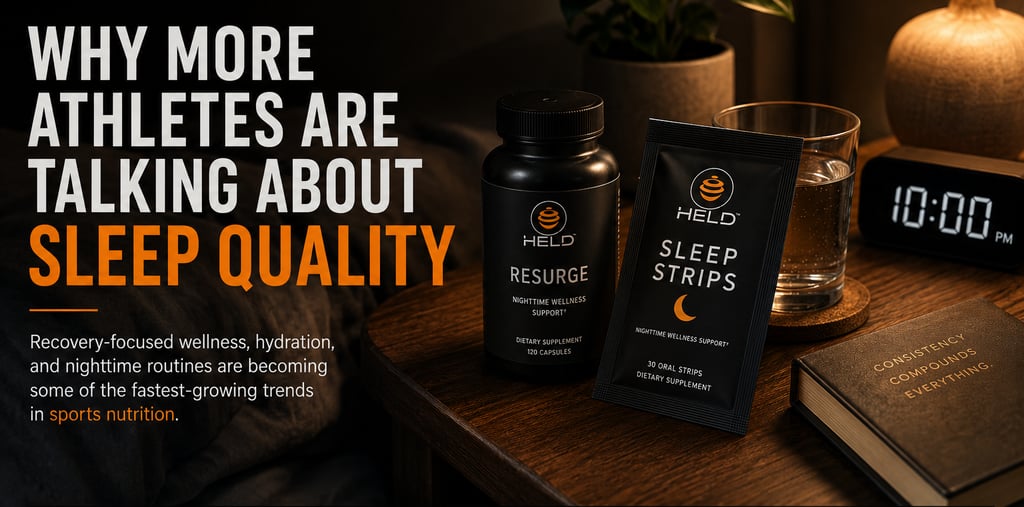
Hydration, recovery habits, sleep quality, adaptogens, and wellness-focused supplementation are becoming some of the fastest-growing conversations in sports nutrition.
Have you ever started a workout knowing exactly what you need to do...
But somehow your body just doesn't seem to cooperate?
The weights feel heavier.
Your pace feels slower.
Your focus isn't where it should be.
And the frustrating part?
You showed up.
You trained consistently.
You followed your plan.
Yet something still feels off.
Increasingly, athletes and active individuals are realizing that performance isn't only influenced by training volume, exercise selection, or motivation.
Sometimes the missing piece is recovery quality.
Why recovery is becoming one of the biggest trends in sports nutrition
For years, sports nutrition focused primarily on intensity.
More volume.
More effort.
More stimulation.
Today, that conversation is changing.
Athletes are increasingly asking:
"How can I stay consistent without constantly feeling exhausted?"
This shift is helping fuel growing interest in:
sleep quality
recovery-focused wellness
hydration habits
nighttime routines
adaptogens
gut health support
sustainable performance strategies
Research published in Sports Medicine has continued exploring the relationship between sleep, recovery behaviors, and athletic performance consistency (Fullagar et al., 2015).
Increasingly, recovery is becoming part of performance itself.
Why so many active people feel "flat"
One of the most common complaints being discussed across fitness communities today is surprisingly simple:
"I don't feel sharp anymore."
Not injured.
Not sick.
Not necessarily overtrained.
Just...
Flat.
Many active individuals report:
inconsistent energy
reduced training enjoyment
difficulty staying motivated
greater perceived effort during normal workouts
feeling mentally disconnected from training
Research continues exploring how sleep quality, psychological stress, hydration practices, and recovery habits interact with training readiness and athlete wellness (Vitale et al., 2019).
The conversation is increasingly shifting from:
"How hard can I push?"
to:
"How well can I recover?"
Sleep quality is receiving renewed attention
One of the biggest wellness trends today is the growing focus on sleep quality.
Research continues highlighting the importance of sleep in athletic recovery, cognitive function, adaptation to training, and overall wellness (Walsh et al., 2021).
As a result, many athletes are paying closer attention to:
nighttime routines
screen exposure before bed
hydration habits
recovery behaviors
structured evening wellness practices
Products such as Sleep Strips and Resurge align with the growing trend toward nighttime wellness and recovery-focused routines among active individuals.
Not because people are looking for shortcuts.
Because they are looking for consistency.
Adaptogens continue gaining momentum
Another major trend in sports nutrition is the growing interest in adaptogenic ingredients.
Adaptogens have been discussed extensively in wellness literature and continue attracting attention among active individuals looking to build sustainable lifestyle habits.
One example is Schisandra, an ingredient increasingly appearing in wellness-focused conversations involving recovery routines and performance lifestyles.
Research reviews discussing adaptogens and stress physiology include:
Panossian & Wikman (2010), Pharmaceuticals
Panossian (2017), Medicines
Products such as Resurge reflect this growing interest in recovery-focused wellness routines built around adaptogenic ingredients.
Gut health is becoming part of the recovery conversation
Another rapidly growing trend:
Gut health.
Athletes and active individuals are increasingly recognizing that digestive wellness may influence how they feel throughout training cycles.
Research published in Frontiers in Nutrition continues exploring relationships between exercise stress, nutrition practices, and gastrointestinal wellness in athletes (Clark & Mach, 2016).
This shift has increased interest in products such as:
which are increasingly being incorporated into broader wellness-focused nutrition routines.
Hydration is no longer just for endurance athletes
Hydration is another area receiving renewed attention.
Research by Sawka et al. and Cheuvront & Kenefick continues discussing the relationship between hydration practices, exercise performance, and athlete wellness.
Today, many active people are realizing that hydration is not simply about thirst.
It is becoming part of a broader recovery strategy.
That awareness is helping drive growing interest in:
electrolyte support
hydration-focused routines
recovery habits
sustainable performance systems
The future may belong to consistency
Perhaps the biggest shift happening today is this:
Athletes are becoming less interested in feeling stimulated.
And more interested in feeling consistent.
That means greater attention to:
sleep quality
recovery habits
hydration
adaptogens
digestive wellness
sustainable routines
Because the best training plan in the world only works if you can keep showing up.
Products That Align With These Trends
Depending on individual goals and professional guidance, active individuals interested in recovery-focused wellness may explore:
Resurge — nighttime wellness and adaptogen-focused recovery routines
Sleep Strips — nighttime wellness routines
Colostrum — gut health and recovery conversations
Glutamine — recovery and digestive wellness discussions
Hydration Support — hydration-focused performance habits
RIGHT — men's wellness and performance lifestyle conversations
Research Referenced
Fullagar HHK et al. Sleep and Athletic Performance. Sports Medicine, 2015.
Vitale KC et al. Sleep Quality and High Intensity Exercise. International Journal of Sports Medicine, 2019.
Walsh NP et al. Sleep and Human Performance. British Journal of Sports Medicine, 2021.
Clark A & Mach N. Exercise-Induced Stress Behavior, Gut-Microbiota-Brain Axis and Diet. Frontiers in Nutrition, 2016.
Sawka MN et al. Exercise and Fluid Replacement. Medicine & Science in Sports & Exercise.
Cheuvront SN & Kenefick RW. Dehydration: Physiology, Assessment, and Performance Effects. Sports Medicine.
Panossian A & Wikman G. Effects of Adaptogens on the Central Nervous System and Stress-Protective Activity. Pharmaceuticals, 2010.
Panossian A. Understanding Adaptogenic Activity. Medicines, 2017.
This content is for informational purposes only. Supplement use, hydration strategies, recovery routines, sleep practices, and wellness habits should always be individualized. Consult a qualified healthcare professional before beginning any supplement routine.
These statements have not been evaluated by the Food and Drug Administration. These products are not intended to diagnose, treat, cure, or prevent any disease.